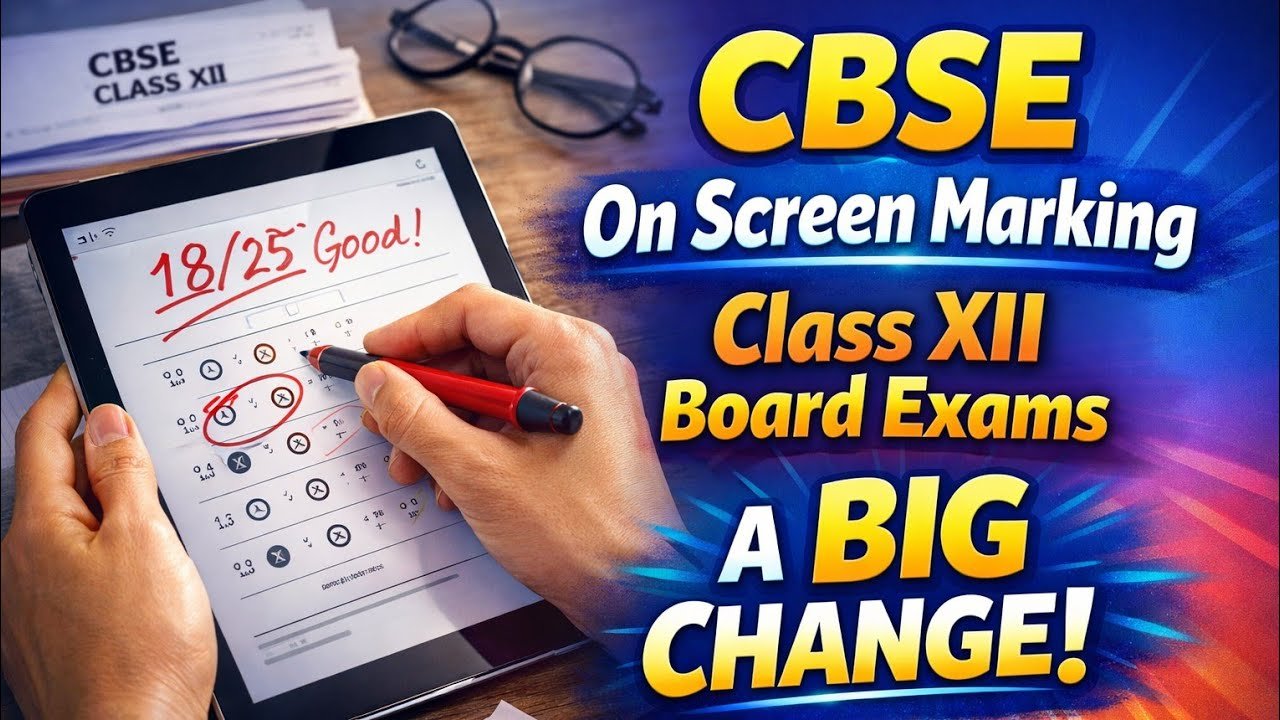
The Central Board of Secondary Education (CBSE) has announced a major change in the evaluation process for Class 12 board examinations — introducing On-Screen Marking (OSM) from the 2026 academic year. This digital evaluation system marks a significant shift from traditional paper-based checking to modern digital assessment, aimed at enhancing accuracy, fairness, and speed in exam results.
What Is On-Screen Marking (OSM)?
On-Screen Marking is a digital evaluation system where teachers review scanned answer sheets on computer screens instead of manually marking physical copies. After exams are conducted in pen-and-paper format, answer books are scanned and converted into digital files that evaluators can access securely online.
Unlike traditional methods that rely on bulk physical handling, OSM allows examiners to:
✔ Check scripts from their own schools or locations
✔ Enter marks directly on a secure platform
✔ Avoid manual totaling errors
✔ Speed up the entire evaluation process
This move aligns with global education trends and is part of CBSE’s effort to modernize assessment procedures.
Why CBSE Is Shifting to Digital Evaluation
CBSE says the new system brings several important advantages:
- Faster Results: Digital checking cuts down time taken for evaluation and mark compilation.
- More Transparency: Direct digital marking reduces human errors and discrepancies.
- Wider Teacher Participation: Examiners won’t need to travel to central evaluation centres.
- Reduced Logistical Load: No physical transportation of answer books, saving time and cost.
- Eco-Friendly: Supports paperless processes and reduces carbon footprint.
The evaluation system for Class 10 board exams in 2026 will remain unchanged and continue with traditional physical marking.
Implementation Plan and School Preparations
To ensure smooth rollout of the new system, CBSE has instructed all affiliated schools to prepare the necessary digital infrastructure. Key technical requirements include:
- Computer labs with public static IP addresses
- Systems with Windows 8 or above and at least 4 GB RAM
- Updated internet browsers and Adobe Reader
- Reliable internet connection (minimum 2 Mbps)
- Uninterrupted power supply
Teachers will be given access through their official OASIS IDs and will receive training to adapt to the new process. Schools can expect dry runs, instructional videos, and helpdesk support from CBSE to aid the transition.
What This Means for Students and Parents
For millions of Class 12 students across India and in 26 countries where CBSE exams are held, this reform is poised to:
- Deliver quicker and more accurate results
- Reduce delays caused by manual tabulation
- Ensure fewer disputes during post-result evaluations
Though the way answer sheets are marked has changed, students will continue to write their answers on paper as before. Only the process of evaluation will now be digital.
Looking Ahead
CBSE’s introduction of on-screen marking for Class 12 boards is an important step toward digital transformation in India’s education system. By blending technology with traditional assessment, the board aims to make evaluations more reliable and student-centric — in line with broader initiatives like Digital India and the National Education Policy (NEP).